

Research
Three 2025 marathons: plans, reported scale and actor roles
Read planned capacity, narrative starters and narrative participants across three named 2025 editions. Cancelled projects remain separate; source amounts are neither summed nor ranked.
Scope
Existing public sources for named 2025 events; local original-research review. Reported scale is not chip-based starts or finish counts, and actor roles are not backfilled across editions.
Abstract
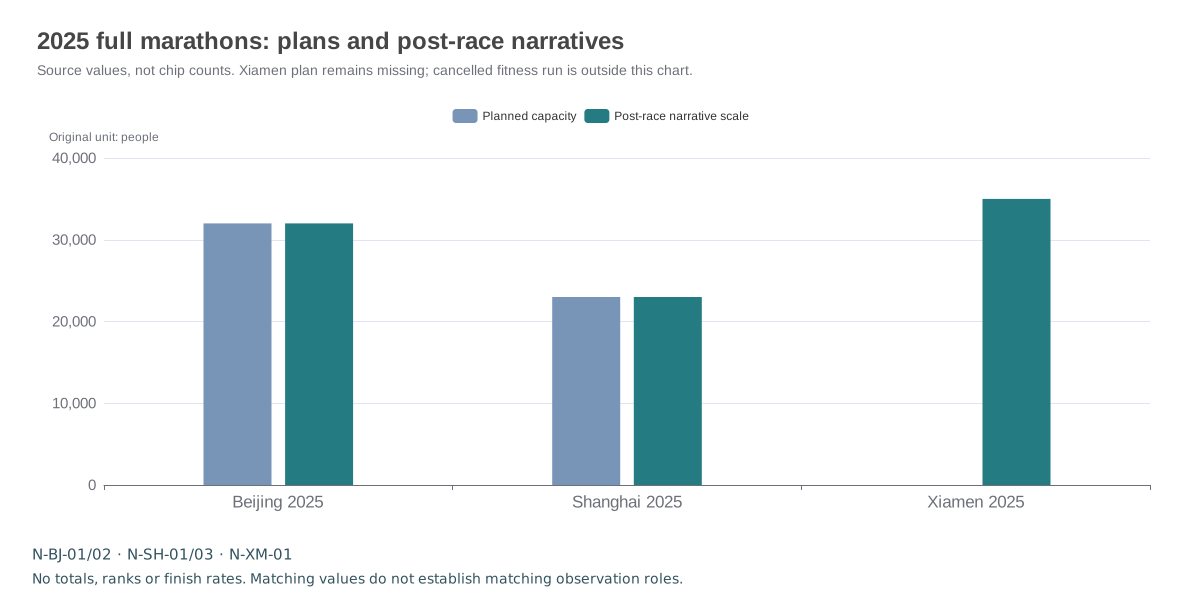
A race’s size is not a single interchangeable number. Existing sources for the 2025 Beijing, Shanghai and Xiamen marathon editions distinguish planned capacity, narratively reported starters and narratively reported participants. Beijing’s documents state 32000 for capacity and reported starters, while Shanghai’s full-marathon sources state 23000 for each role. Matching numbers do not establish a chip-verified starting count, registration count, finish count or completion rate. Shanghai’s separately planned 15000-place fitness run was cancelled, so it cannot be added to the full marathon’s reported scale. Xiamen’s post-race account describes 35000 participants; a comparable planned-capacity observation was not established in this evidence selection. The chart preserves these roles and leaves the missing plan unfilled. This article interprets six existing observations within their named editions. It does not aggregate race populations, infer economic impact or turn organizational, operational or sponsorship relationships into a composite quality rating.
6 section citations
- Chinese-language source page (www.beijing-marathon.com) ↗
- Chinese-language source page (www.csig158.com) ↗
- Chinese-language source page (static.shang-ma.com) ↗
- Chinese-language source page (media.shang-ma.com) ↗
- Chinese-language source page (www.xmim.org) ↗
- Chinese-language source page (static.shang-ma.com) ↗
Identify the role before reading the number
Before reading a race announcement, identify whether its number describes capacity, registrations, expected starters or a post-race account. Capacity describes places offered. Narrative post-race scale describes what the publisher reports about that edition; it does not acquire the evidential status of timing records. Beijing’s 32000 and Shanghai’s 23000 each appear in two role-specific observations and remain separate even when their number strings match. The table preserves all six original IDs, number strings and units. Its order expresses no quality judgment. Xiamen’s comparable planned observation remains missing rather than zero, and is not supplied from another edition or the current homepage.
6 section citations
- Chinese-language source page (www.beijing-marathon.com) ↗
- Chinese-language source page (www.csig158.com) ↗
- Chinese-language source page (static.shang-ma.com) ↗
- Chinese-language source page (media.shang-ma.com) ↗
- Chinese-language source page (www.xmim.org) ↗
- Chinese-language source page (static.shang-ma.com) ↗
Scroll the table to see all fields; original units are retained.
| Edition / project | Source role | Original number | Original unit | Observation ID |
|---|---|---|---|---|
| Beijing 2025 marathon | Planned capacity | 32000 | people | N-BJ-01 |
| Beijing 2025 marathon | Narratively reported starters | 32000 | people | N-BJ-02 |
| Shanghai 2025 marathon | Planned capacity | 23000 | people | N-SH-01 |
| Shanghai 2025 fitness run | Cancelled planned capacity | 15000 | people | N-SH-02 |
| Shanghai 2025 marathon | Narratively reported starters | 23000 | people | N-SH-03 |
| Xiamen 2025 marathon | Narratively reported participants | 35000 | people | N-XM-01 |
How the figure separates plans from reported scale
The figure separates full-marathon plans from post-race narratives and leaves Xiamen’s planned slot empty. Shanghai’s cancelled 15000-place fitness-run plan remains in the table, outside the full-marathon bars. The five plotted amounts are existing observations, without a new estimate. Equal numbers establish matching source lexemes, not registration conversion, verified starts or a finish rate.
Scroll horizontally within this figure to read all fields.
6 section citations
- Chinese-language source page (www.beijing-marathon.com) ↗
- Chinese-language source page (www.csig158.com) ↗
- Chinese-language source page (static.shang-ma.com) ↗
- Chinese-language source page (media.shang-ma.com) ↗
- Chinese-language source page (www.xmim.org) ↗
- Chinese-language source page (static.shang-ma.com) ↗
Keep amendments and actor roles within the edition
Shanghai’s original rules must be read together with the later amendment. The fitness-run places describe an earlier arrangement; following cancellation, they are a cancelled plan rather than a smaller realized event. Hosts, organizers, operators, co-organizers, technical certification, sponsors and support relationships should retain their original labels. Brand sponsorship does not prove race operation or create a legally verified marketing-services company. These sources describe a particular edition and its projects. Names are not new-company counts, and roles cannot be filled from other editions or a current homepage. Further role research must preserve the event, project, year and evidence role.
6 section citations
- Chinese-language source page (www.beijing-marathon.com) ↗
- Chinese-language source page (www.csig158.com) ↗
- Chinese-language source page (static.shang-ma.com) ↗
- Chinese-language source page (media.shang-ma.com) ↗
- Chinese-language source page (www.xmim.org) ↗
- Chinese-language source page (static.shang-ma.com) ↗
What the evidence supports and what remains
The deliverable is a role-labelled source reading: which amount is a plan, which is a post-race narrative, which plan was cancelled, and which fields remain unestablished. A finish rate needs a compatible project denominator and actual finish statistics; economic-impact analysis needs a separate survey method, sample and inference scope. Those inputs are absent here, so neither estimate is produced. Further work should establish missing role evidence and amendment chains before attempting narrowly defined comparisons. Original units and all six IDs remain unchanged. Source reports and the linked studies allow verification without copying full documents, source images or personal entrant lists.
6 section citations
- Chinese-language source page (www.beijing-marathon.com) ↗
- Chinese-language source page (www.csig158.com) ↗
- Chinese-language source page (static.shang-ma.com) ↗
- Chinese-language source page (media.shang-ma.com) ↗
- Chinese-language source page (www.xmim.org) ↗
- Chinese-language source page (static.shang-ma.com) ↗
Sources & retrieval dates
- Chinese-language source page (www.beijing-marathon.com) ↗
- Chinese-language source page (www.csig158.com) ↗
- Chinese-language source page (static.shang-ma.com) ↗
- Chinese-language source page (media.shang-ma.com) ↗
- Chinese-language source page (www.xmim.org) ↗
- Chinese-language source page (static.shang-ma.com) ↗