

 Source specification chart
Sports flooring
Reading Indoor Sports Roll Coverings: Physical Specifications and Evidence Boundaries
Three Taraflex documents and two specification questions: thickness, mass per area and a reproducible scenario reveal what the data can and cannot support.
Scope
Three same-publisher series documents, limited to declared specifications. UK webpage context does not establish Chinese supply. Orderable SKU, independent testing, installed systems and site safety remain unverified. PDF maximum length and webpage-listed length coexist; actual supply length is pending.
What this comparison can answer
Venue material selection often begins with thickness and weight. The harder question is whether those figures describe a roll covering or a complete floor incorporating adhesive, subfloor and other layers. This study reads the Gerflor UK documents for Taraflex Multi-Use, Evolution and Performance as indoor sports roll-covering specifications. Their publisher-stated uses overlap, but this does not establish interchangeability. [S01–S06]
The three documents form a purposive small sample, not a cross-brand review or a survey of Chinese supply. The existing records identify named series; specific orderable models remain unknown. SL, Drytex, Subflex, portable variants and wood-floor coatings are excluded. These boundaries avoid superficial comparisons between different constructions.
Three sets of figures, two different questions
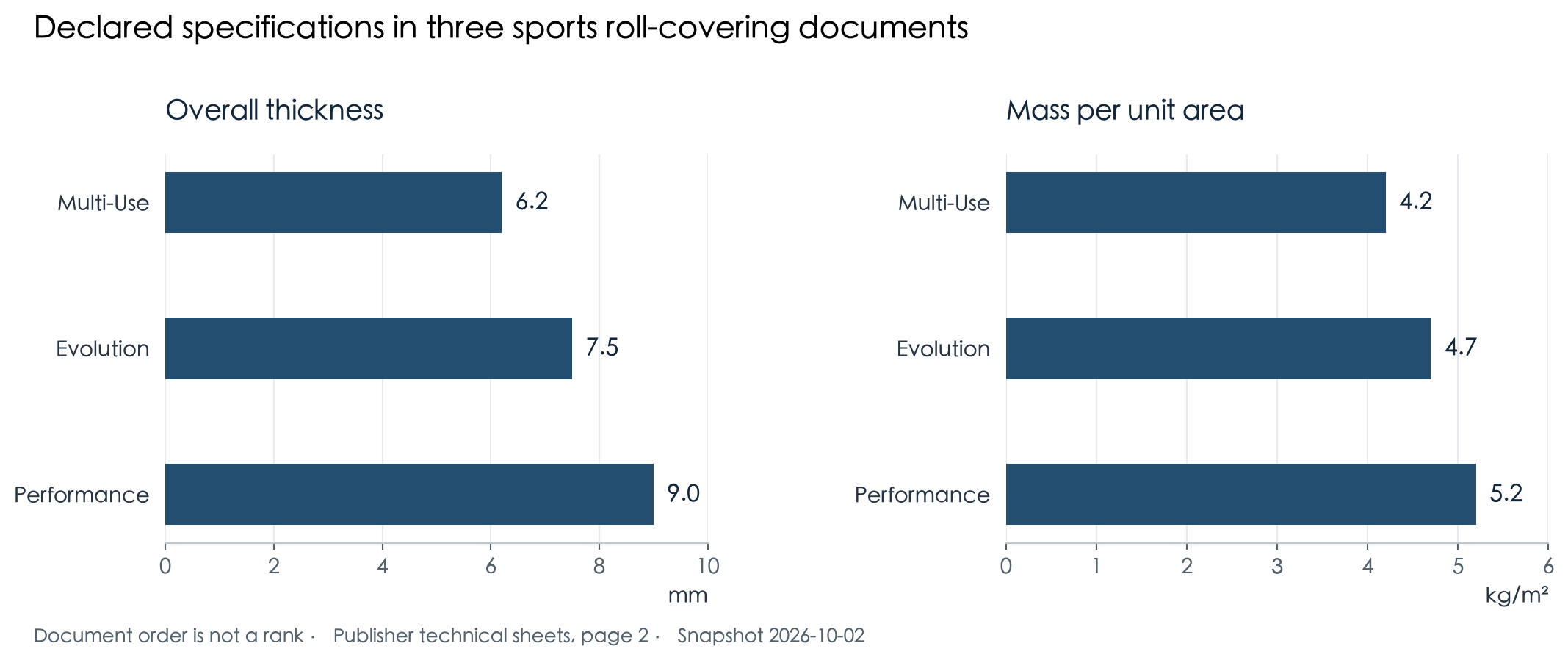
Page 2 of the technical sheets states 6.2 mm and 4.2 kg/m² for Multi-Use, 7.5 mm and 4.7 kg/m² for Evolution, and 9.0 mm and 5.2 kg/m² for Performance. Overall thickness describes a dimension of the cited covering; mass per unit area describes material mass for a given area. The field named Weight uses kg/m² and must not be read as weight per roll. [S01–S03]
Both figures increase in this document order. Three declared observations do not show that thicker is better or heavier is more durable. Normalizing and adding them would introduce unsupported directions of merit and weights. Each measurement therefore retains its own unit and panel; no composite score is calculated.
Scroll horizontally within this figure to read all fields.
3 section citations
Scroll the table to see all fields; original units are retained.
| Document context | Overall thickness / mm | Mass per unit area / kg/m² |
|---|---|---|
| Taraflex® Multi-Use | 6.2 | 4.2 |
| Taraflex® Evolution | 7.5 | 4.7 |
| Taraflex® Performance | 9.0 | 5.2 |
A shared method number is not a shared test
The sheets cite EN ISO 24346, EN ISO 23997 and EN ISO 24341 for thickness, mass per unit area, and length/width. Public ISO catalogue entries identify the corresponding measurement subjects. This helps interpret the labels; it does not mean AO performed or witnessed the tests. [S01–S03, S07–S09]
These rows do not establish the test edition, batch, sample size, test date or tolerance. Catalogue edition years are not imputed to product tests. Requirement and Result columns must be read separately: a requirement is not automatically a measured result. Sports performance, load capacity, certification validity and installed-site safety are excluded from this evaluation.
6 section citations
Keep the roll-length discrepancy visible
All three PDF sheets list width as 1.5 lm; the UK pages list 1.5 m. The original notation is retained while width is recorded in metres. Roll length is different: the PDFs state 26.5 max lm, whereas the webpages list 20.5 m. These observations belong to the 2 October 2026 source snapshot, when the webpages linked the corresponding sheets. [S01–S06]
A maximum of 26.5 and a webpage-listed 20.5 are different statements. Supply options or revisions might explain the difference, but no explanation has been established. Neither value is silently chosen or averaged. Actual order length remains unverified, so roll counts, per-roll mass and covered-court counts are not calculated. Region, order code and applicable document require confirmation at quotation.
A reproducible material-mass scenario
For an explicit arithmetic example, assume 500 m² of net coverage with zero wastage. Area multiplied by the stated mass per unit area gives 2,100 kg, 2,350 kg and 2,600 kg; adjacent differences are 250 kg. The area is an author-defined hypothetical input, not a real project. Readers can substitute an area and recalculate without hidden weights. [S01–S03; author calculation]
The result covers roll material only. It excludes cutting allowance, welding-related materials, adhesive, subfloor, packaging and other construction. It is not shipping gross weight, installed-system dead load, structural compliance, an order quantity or installed cost. Price, construction conditions and a system specification would be required for a value-for-money conclusion.
3 section citations
Scroll the table to see all fields; original units are retained.
| Document context | Hypothetical net area / m² | Covering-only net mass / kg |
|---|---|---|
| Taraflex® Multi-Use | 500 | 2100 |
| Taraflex® Evolution | 500 | 2350 |
| Taraflex® Performance | 500 | 2600 |
Evidence boundaries matter more than filling every cell
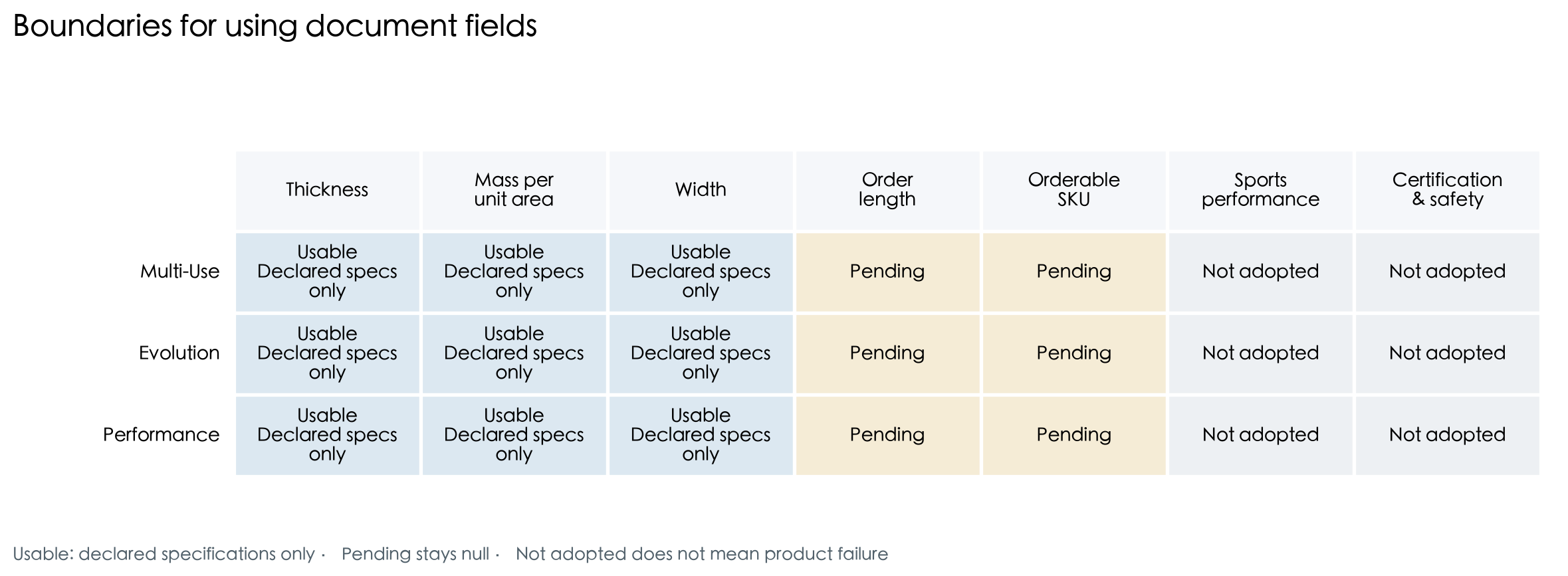
Usable means usable solely for bounded comparisons of publisher-declared specifications; it does not mean independently validated. Pending retains unresolved order length and SKU fields as null. Not adopted excludes sports-performance and certification/safety inferences. Missing values are neither zeros nor borrowed from nearby models.
Figure 1 uses separate axes for thickness and mass per unit area. Figure 2 presents field-use boundaries rather than brand scores. Its 21 cells contain 9 usable, 6 pending and 6 not-adopted entries. The separate evidence register contains 30 rows: 18 usable (15 source observations and 3 author calculations), 6 pending and 6 not adopted. These denominators must not be mixed.
A webpage link, downloaded sheet and screenshot belong to one source chain, not three independent validations. The six product documents still come from one publisher. Original observations, normalized values and arithmetic results retain distinct roles.
Scroll horizontally within this figure to read all fields.
0 section citations
Scroll the table to see all fields; original units are retained.
| Document context | Thickness | Mass/area | Width | Order length | SKU | Sports performance | Certification/safety |
|---|---|---|---|---|---|---|---|
| Taraflex® Multi-Use | Declared specs only | Declared specs only | Declared specs only | Pending | Pending | Not adopted | Not adopted |
| Taraflex® Evolution | Declared specs only | Declared specs only | Declared specs only | Pending | Pending | Not adopted | Not adopted |
| Taraflex® Performance | Declared specs only | Declared specs only | Declared specs only | Pending | Pending | Not adopted | Not adopted |
Leave a traceable record for the next reader
The review snapshot is 2 October 2026. It is neither a product publication date, test date nor performance reporting period. Publication and revision dates remain unverified, so access dates do not establish the latest version. Citations retain exact URLs, page locators, original units and source identifiers. Machine-readable tables retain formulas and reasons for missing fields. [S01–S06]
The supported outputs are specification interpretation, a material-mass order of magnitude and questions for a later quotation. They do not establish a best brand, universal suitability, certification validity or safety. Selection requires a specific configuration, applicable reports and separate assessment of site conditions.
Sources & retrieval dates
- S01 · Taraflex® Multi-Use technical data sheet ↗
- S02 · Taraflex® Evolution technical data sheet ↗
- S03 · Taraflex® Performance technical data sheet ↗
- S04 · Taraflex® Multi-Use | Gerflor UK ↗
- S05 · Taraflex® Evolution | Gerflor UK ↗
- S06 · Taraflex® Performance | Gerflor UK ↗
- S07 · ISO 24346:2006 — Overall thickness ↗
- S08 · ISO 23997:2007 — Mass per unit area ↗
- S09 · ISO 24341:2006 — Length, width and straightness of sheet ↗
Documented source dates
- Source acquisition record
- Source acquisition record
- Source acquisition record
- Source acquisition record
- Source acquisition record
- Source acquisition record