

Research
Reading health support: project attendances and nutrition revenue
Keep institute project attendances separate from CPT sports-nutrition food revenue; project outputs and sales do not establish clinical efficacy.
Scope
Named Institute of Sports Medicine project actuals for 2024–2025 and CPT 2025 product-category revenue; related AOIC-10 health support, without personal medical data.
Abstract and core findings
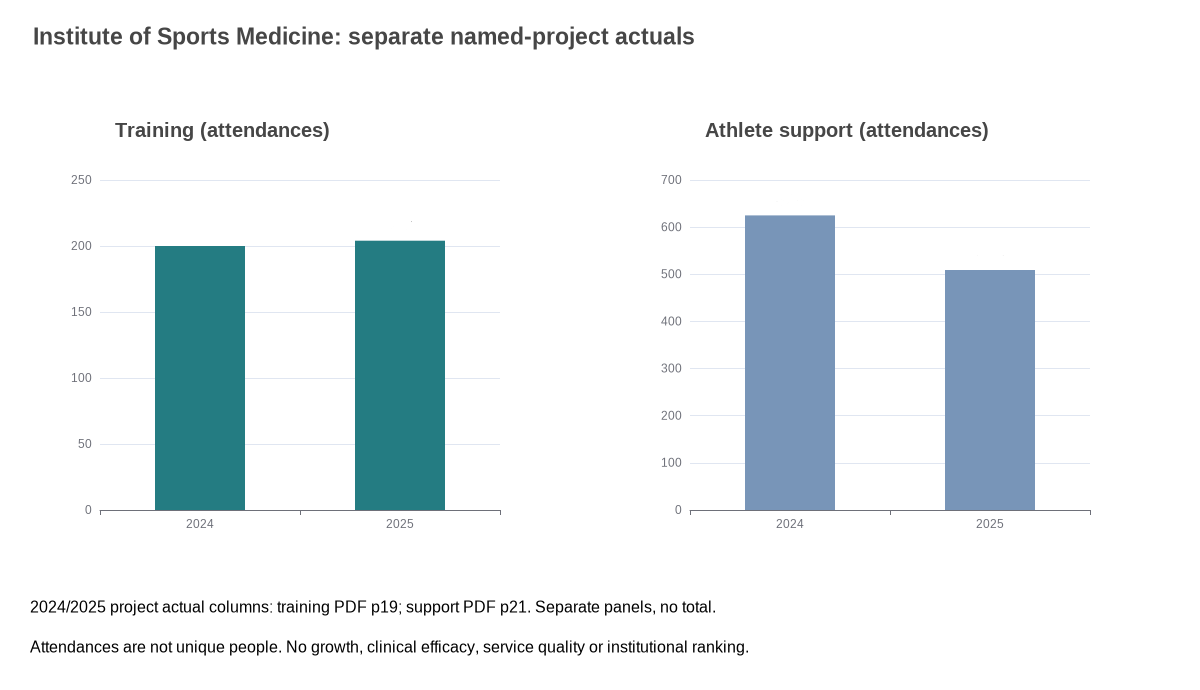
Health-support evidence contains different types of observation. Training attendances and athlete-support visits in named institutional project tables describe reported delivery outputs. Sports-nutrition food revenue describes a named issuer’s business sales. Neither provides direct evidence of therapeutic, preventive or nutritional-intervention effectiveness. This article preserves four actual project observations: 200 and 204 training attendances, and 625 and 509 athlete-support visits, in 2024 and 2025 respectively. A separate observation records 2025 sports-nutrition food revenue of CNY 879728937.76. Attendances remain attendances rather than deduplicated people, and targets do not replace actuals. Sales are not pooled with other business categories or with institutional outputs. The chart separates the two project measures and the table retains their original scope. Clinical claims would require intervention, outcome, follow-up and denominator evidence that these project and revenue disclosures do not supply. The findings therefore concern source-defined output and business scope rather than provider quality or product efficacy.
Actual attendances and targets have distinct roles
The 2024 source explicitly includes online participants in its 200 training attendances. Although 204 is the same institution’s 2025 actual column, a bridge for online participation and service composition is unresolved, so movement cannot be interpreted as improved homogeneous service quality. The athlete-support field uses wording translated as people, but the table’s measurement unit is attendances; 625 and 509 therefore remain visits rather than unique athletes. Targets and actuals also have different roles: the 2025 support record’s target of 500 is not interchangeable with its actual of 509. This table selects actuals only and imputes no outcome from a target. Training and support may contain repeated participation, so their counts cannot be added into a total beneficiary population.
2 section citations
Scroll the table to see all fields; original units are retained.
| Year | Named project metric | Reported actual: source value | Original unit | Observation ID |
|---|---|---|---|---|
| 2024 | Training attendances | 200 | attendances | ISM2024-training_attendance |
| 2024 | Athlete-support visits | 625 | attendances | ISM2024-athlete_support_visits |
| 2025 | Training attendances | 204 | attendances | ISM2025-training_attendance |
| 2025 | Athlete-support visits | 509 | attendances | ISM2025-athlete_support_visits |
A project-output chart is not an efficacy chart
Training and athlete support occupy separate panels, each displaying the 2024 and 2025 actual attendances. There is no shared total, growth calculation, rank or efficacy axis. Annual project actuals identify outputs reported by the publisher. Without cases, defined interventions, follow-up and appropriate comparison denominators, bar height cannot measure health improvement. Tracing a reported delivery output and validating clinical effects are different research questions; this chart answers only the former.
Scroll horizontally within this figure to read all fields.
Nutrition-food sales: interpret within the reported category
CPT’s 2025 sports-nutrition food revenue is reported as CNY 879728937.76 within its annual product-category disclosure. The amount informs readers about that selected business’s reported sales, but it does not demonstrate any product’s effects on sports performance or disease. Health nutrition, contract manufacturing and digital services are not automatically included in sports-nutrition food; dividing this revenue by institute service visits would also mix unrelated observation scopes. The selected evidence provides only a 2025 point for this metric. No missing years are filled from group amounts, no multi-year trend is invented, and revenue size does not become an institutional or product recommendation.
1 section citations
Scroll the table to see all fields; original units are retained.
| Year | Product category | Reported revenue: source value | Original unit | Observation ID |
|---|---|---|---|---|
| 2025 | Sports-nutrition food | 879728937.76 | CNY | CPT-LISTED-2025-sports_nutrition_food_revenue |
Scope and further evidence
This article links the health-support sector to the existing institutional-output and nutrition-revenue detail pages. The evidence supports interpretation of named project actuals, units and sales categories; it does not replace individual care, product-effect trials or medical-provider certification. Further research would first need service-composition and participation-deduplication definitions, then intervention and outcome evidence appropriate to a specific question. Without those materials, preserving uncertainty is more accurate than creating a composite score. No personal health records or full original reports are added here.
Sources & retrieval dates
- Chinese-language source page (www.sport.gov.cn) ↗
- Chinese-language source page (www.sport.gov.cn) ↗
- Chinese-language source page (static.cninfo.com.cn) ↗